


Most technical software products have a similar problem with their ad funnels: the conversion rate is so low that it's hard to test anything and get meaningful data back.
While all the e-commerce shop owners boast on LinkedIn about the ad tests they are running weekly, or B2B SaaS marketers share their fancy playbooks on using Claude to automate ad management, none of this is relevant in the devtool space - and it doesn't work at all there.
Most advertising experimentation out there has been done for high-volume, simple products and services. Devtools are not high-volume and not simple.
Generally, we see two default paid media funnels that devtools marketers try to use: the “free signup” version and the “book a demo” version. Both these funnels can work, and they can get results, but not if you set them up in a naïve way.
Let’s run through examples of both, get an understanding of what is actually happening, and explain what can be done to finally have workable conversion rates in each flow.
Funnel A: The free-signup funnel
This one starts with an ad click, which brings the user a page that promotes a free signup action. The idea is that the user comes to the page, learns the benefits of the product, signs up for free, uses the product for free for some time - and then likes it so much that they upgrade to a paid plan.
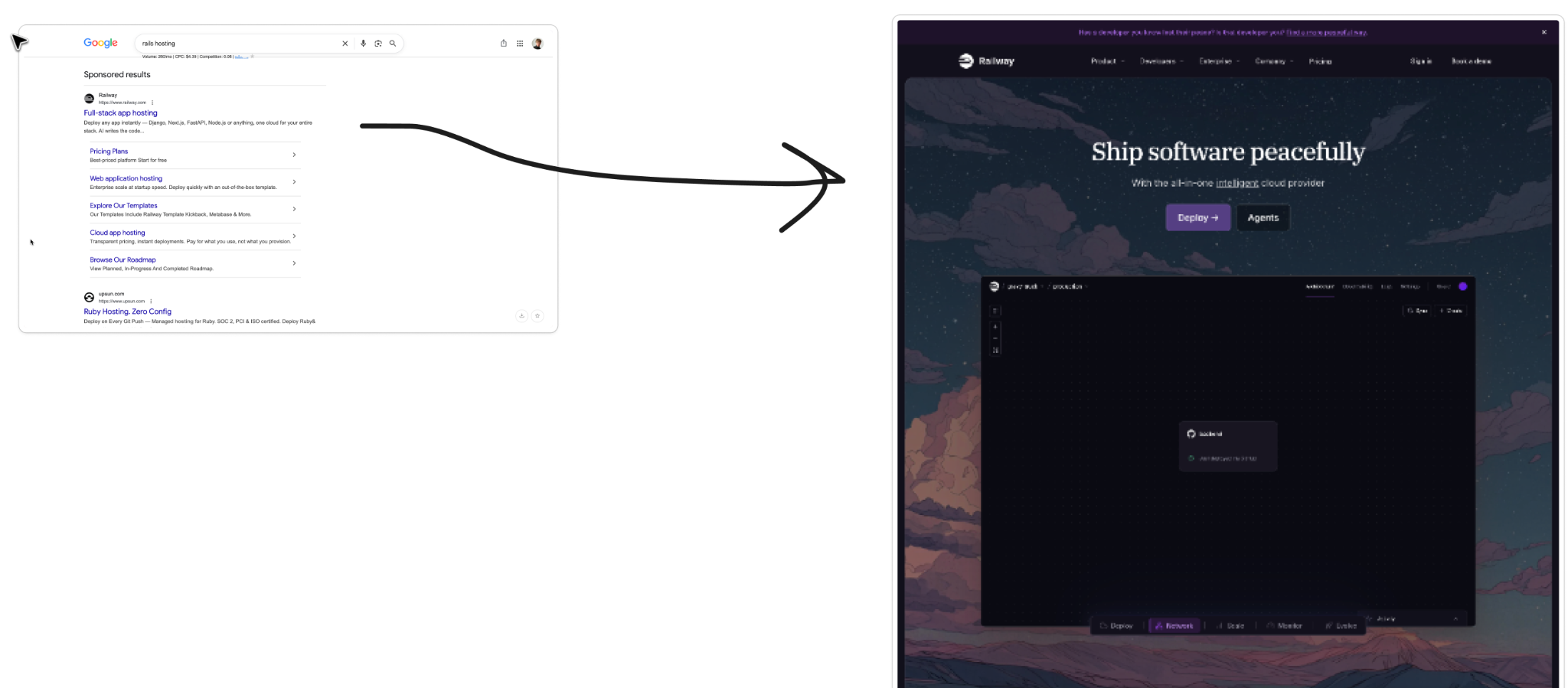
This funnel is the bread and butter of all SaaS. There is a problem with this approach though: the landing page has only one CTA, meaning anyone who’s not ready to sign up at that moment has no other options. In a normal flow, most people aren’t ready to sign up based on so little information, so most of them leave and never come back to the product.
This could have worked in 2015, 2020, even 2022, but in 2026 the cost of ad clicks is up by 2-10x compared to 2020, the competition in most devtool categories has increased significantly, leading to high costs and few signups. Even high-quality products with the best landing page design and copy may have conversion rates as low as 0.1% on this type of setup.
This has completely destroyed the advertiser economics in the devtools space for this funnel type.
The economics: Worked example
- Two hundred clicks at a realistic DevTool CPC (say, $6–10)
- Assume 0.5% conversion rate (decent)
- One signup
That signup must convert to a paid customer and retain long enough to pay back the entire spend.
- $6 CPC × 200 clicks = $1,200 traffic cost
- 1 sign up → $1,200 cost per signup (unsustainably high for a product-led motion)
This doesn’t make sense unless there is almost a guarantee that this signup will convert into paid and pay $10,000+ in lifetime value. Which is not going to happen for almost any PLG product.
Funnel B: The demo funnel
The demo funnel generally takes an extreme approach in the other direction: rather than relying on the user trying the product and upgrading, the advertiser places a demo request for the product on the landing page.
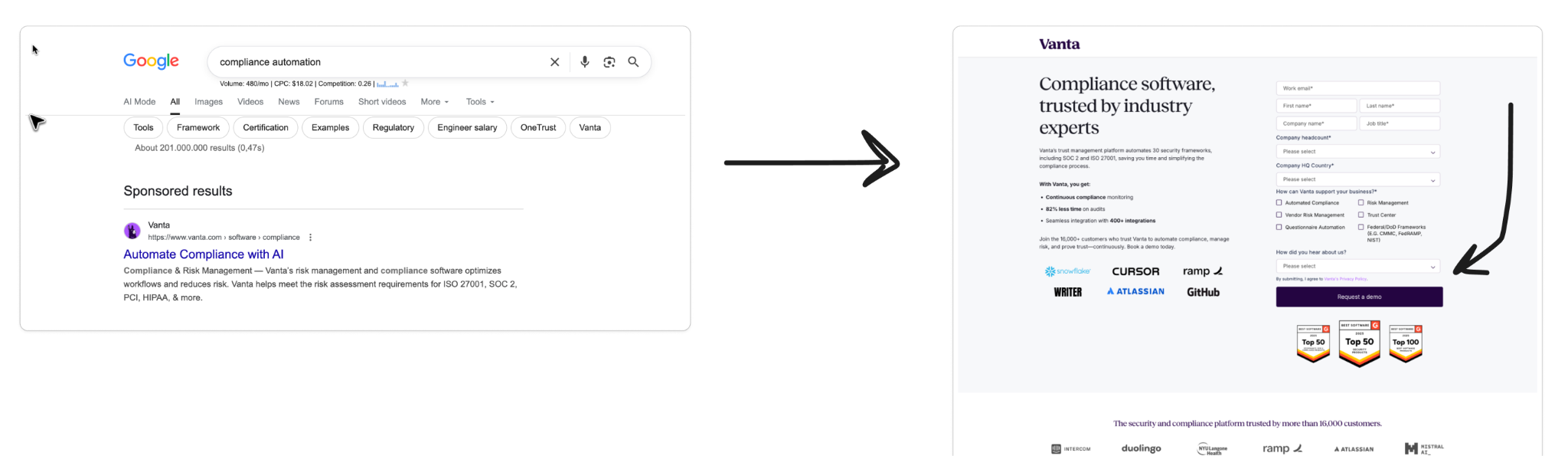
However when you look at how most devtool and deep tech companies implement this approach, it tends to feel like a pure gate rather than a sustainable conversion mechanism.
On most book-a-demo pages, there’s no information beyond the very basics, meaning that for a complex product, the visitor comes with ten questions, and the page doesn’t answer any of them. It simply asks for their email address.
The reason why most pages are being structured this way is yet again cost. At the current high costs of driving users to a book-a-demo funnel for technical software, companies believe they can't afford to have anyone drop out of the funnel once they are on the page. And as a fix, they share as little information as possible and everything else becomes a demo discussion with a salesperson.
This approach causes a massive set of issues however:
- Most devtool companies are really bad at following up with leads and converting them. Even if you manage to get a consistent stream of demo requests, most devtool team will close very few opportunities.
- Prospects arrive at the demo with very little context, making the sales process difficult - lots of information that needs to be put into their heads in just a 30-minute demo. This leaves almost no time for any real questions or objections that the demo call is supposed to be for!
- Getting prospects to submit a demo request requires a lot of brand equity. Vanta’s demo page does actually convert, but it’s not because the page does anything special. It’s because Vanta has invested in its brand being everywhere, for years, and that brand presence does the heavy lifting, the trust building, and builds the depth required to convert the visitor before they click. The page is not really a pitch, it's a receipt rather. If you were to duplicate that page for an unknown company, then the results would be close to zero, regardless of the ad spend. The ad and the page are simply taking advantage of the work already done by the brand. There’s no persuasion or clarification going on here.
In our opinion, most companies wanting to use this funnel can't use this funnel profitably.
The shared root cause
Both funnels fail for the same reason: Complex products create an informational deficit that no single page can close. A visitor already knows how the free signup and demo funnels work, they have ten questions but get maybe three of them answered on the landing page, and then they have to leave the funnel to gather more information - into docs, videos, Google, and so on.
Much of the conversion-relevant activity with the above two funnel options happens off-page, unattributed even if successful, but mostly it's unsuccessful.
Rather than trying to replace the classic funnels with a slightly better structure, we believe any kind of step-function performance improvement can only come from a dramatic change in funnel type.
What works instead: Destinations that educate
In order to convert someone directly on the page they've landed on from ads, the page has to a) answer their specific questions, and b) offer a low-commitment way to move forward which corresponds to the low level of trust.
On the back-end, this funnel has to have some sort of structure that eventually takes the user into what you actually want them to do, such as using your software or booking a sales conversation.
Here are four examples of funnels that can achieve this.
The webinar recording funnel
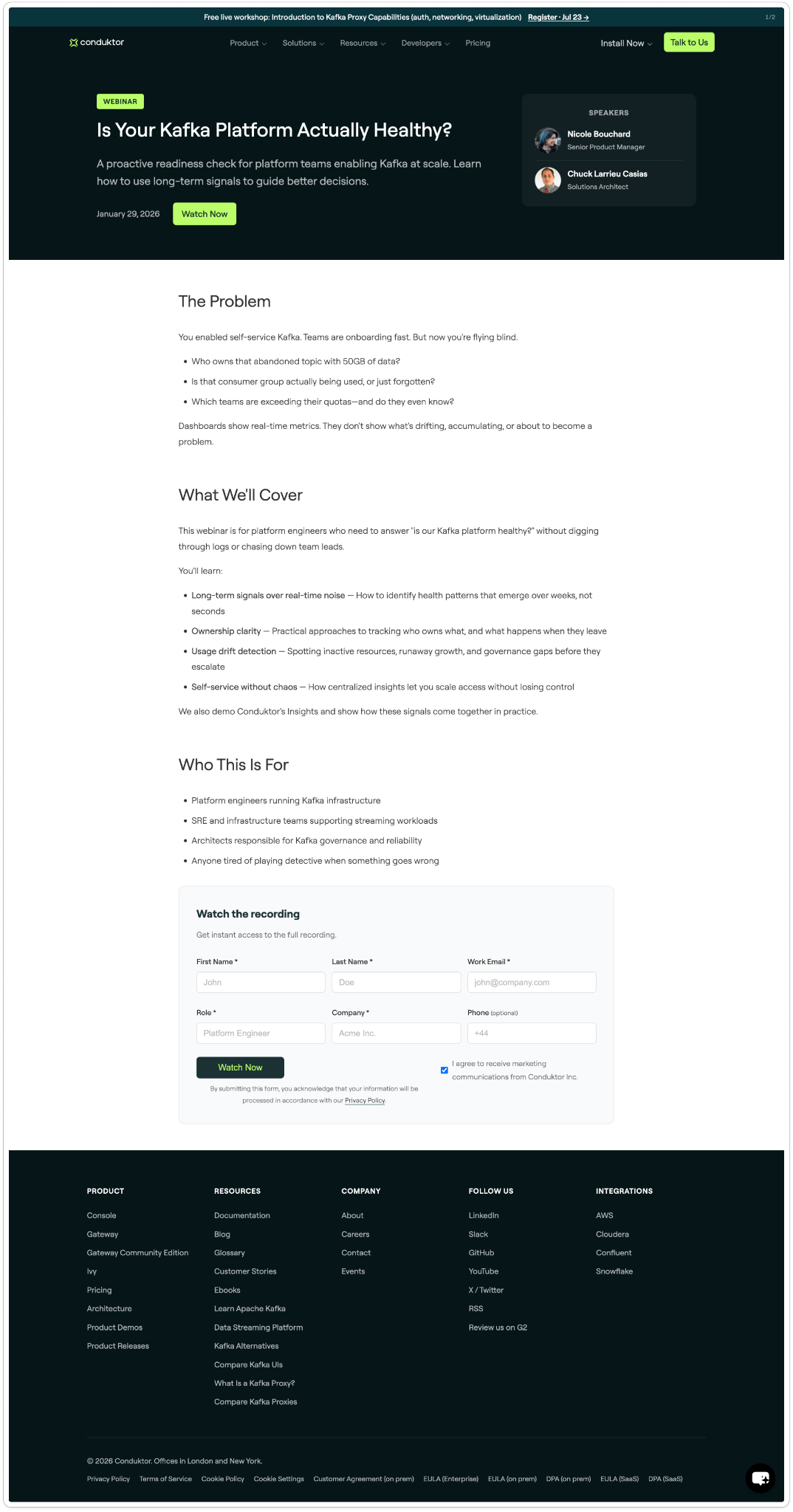
Conductor runs ads to a recorded webinar instead of a book-a-demo page. The page tells you exactly what the recording covers, who’s speaking, and what you walk away with. Then, you fill in a short form and watch immediately.
Why is this effective?
- Because there is zero waiting for a scheduled slot.
- Because it's clear what information you'll get, and who'll present it (clearly it's someone qualified).
- Taking action requires no commitment other than the time to watch the webinar.
Why does it convert? The visitor with ten questions gets forty minutes of answers instead of a headline and a button. And in a feed full of AI-generated filler, real faces signal that real people made this and this is something that you can benefit from.
One caveat: The topic has to be specific. “The future of search” isn’t going to convert. “How to structure docs for AI answers” has a much higher chance of pulling in your target audience.
The case study funnel

The Rulebook Company runs ads straight to a case study: how a customer saved $12M. The figure quoted is impressive enough in the AI space where most can't prove anything, and does the heavy lifting.
The customer in the case study is anonymized, which would weaken the value of the case study in most industries. However, in regulated spaces it is OK. Your prospects know their own legal team would demand the same, so the anonymity reads as normal and potentially even credible.
The caveat: The outcome has to be concrete. “Improved efficiency” is not sufficient. In order for this to work, you would ideally have a dollar figure, a percentage, a before and after. The improvement needs to be credible, even if anonymous.
The book funnel
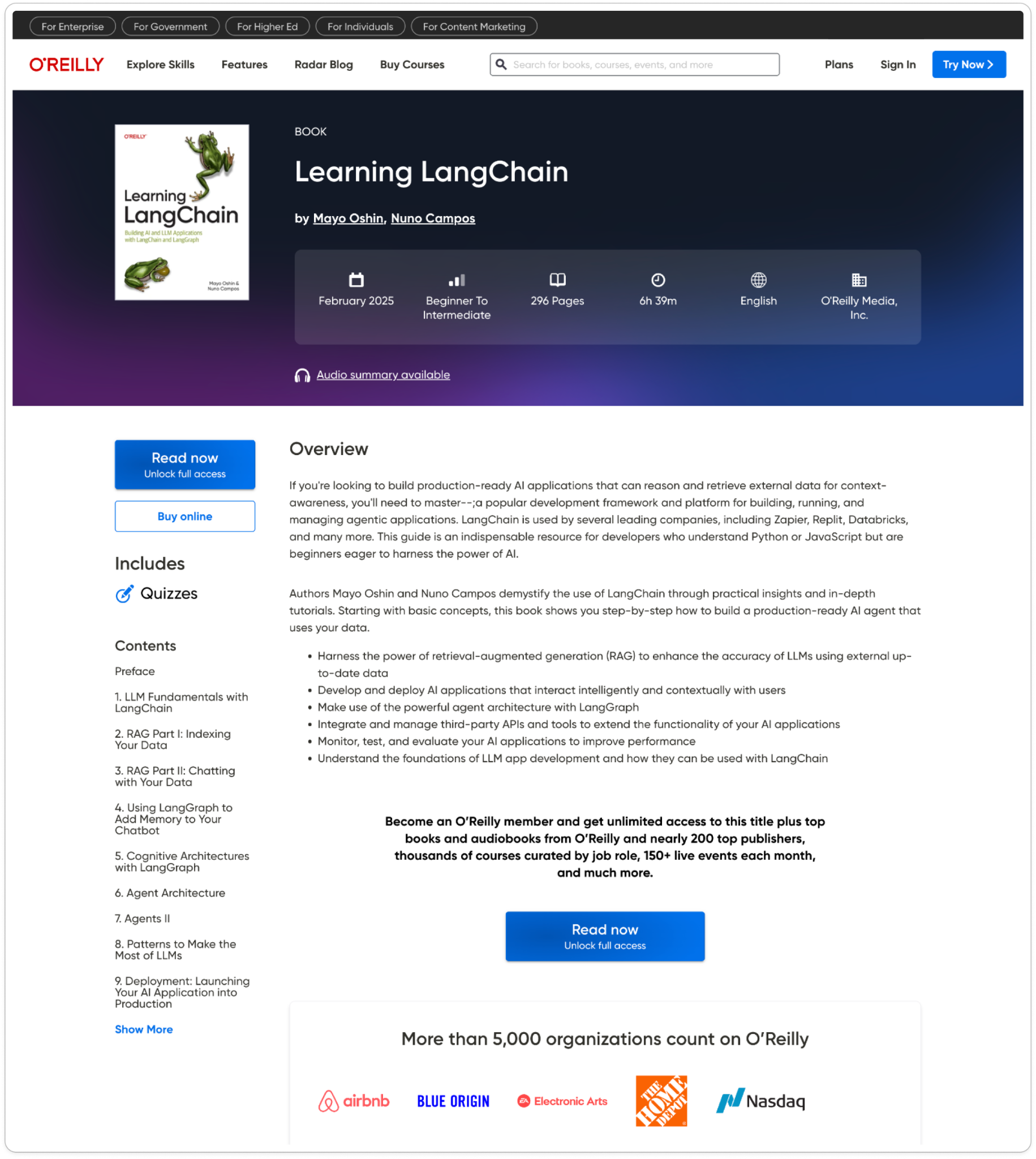
Yet another ad for a book or whitepaper? No thanks (as the assumption is that most books published by companies aren't good).
LangChain does this differently: the book being promoted is a published O’Reilly edition.
Why does it convert? O’Reilly is probably the best-known publisher in the software space and has spent decades earning trust with developers. People pay $25-$200 for O’Reilly books on Amazon, and many developers have bought a book from them just in the past year or two. So when the gate is a real book from a real publisher, the exchange feels fair. You hand over your email and get something significant with a spine.
Compare that with the standard whitepaper PDF. It just gets ignored, and even if someone downloads it, they likely skim it and forget about it. The valued book gets read, kept, and mentioned to a colleague.
The obvious caveat: You probably don’t have a published book. But a substantial, honest technical resource beats a thin lead magnet every time.
And if you do have a published book and you're not promoting it via paid… Please reconsider!
The technical video walkthrough
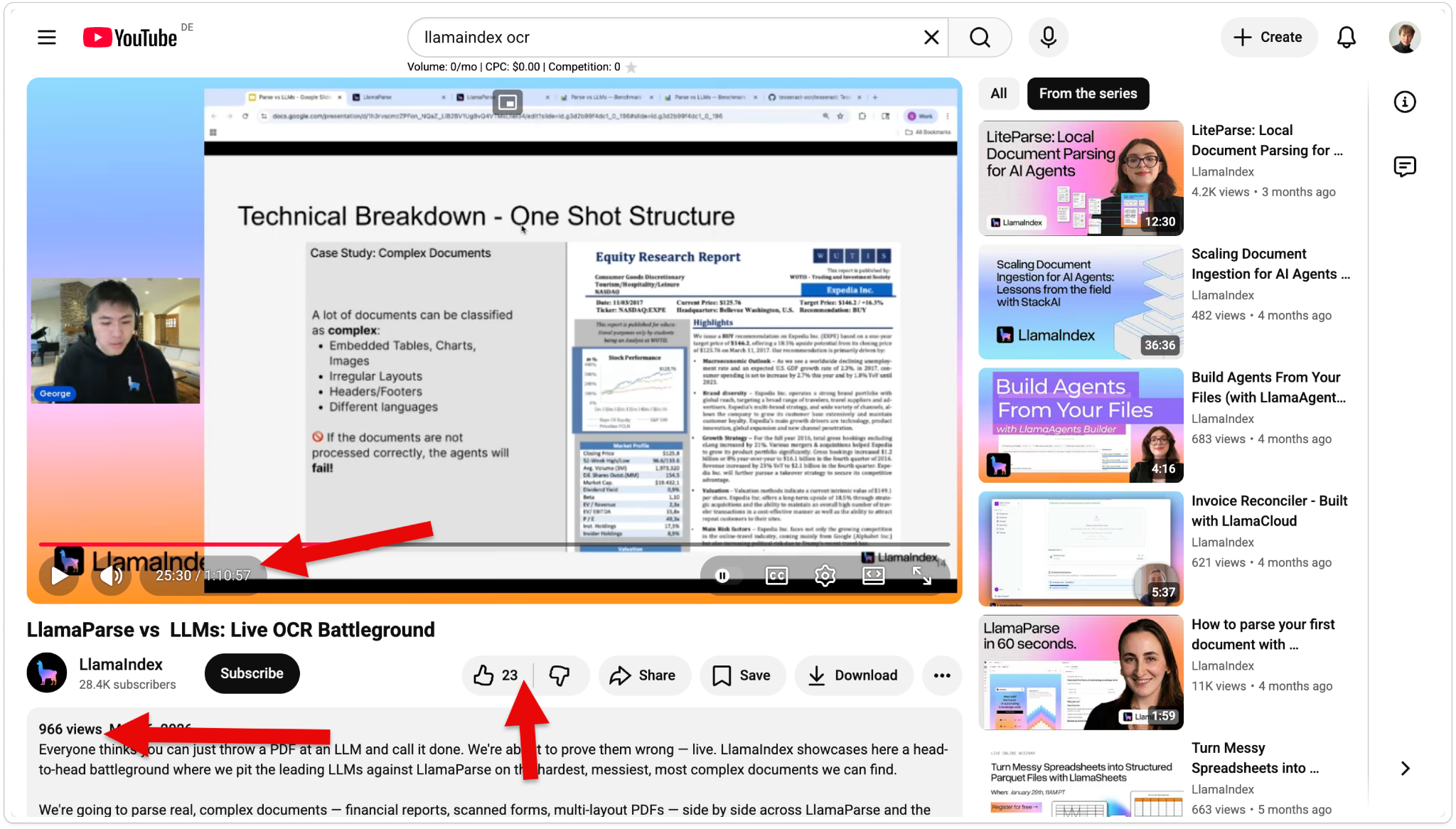
LlamaIndex published a one-hour video comparing frameworks in proper technical depth. The only people who watch an hour of content are those who are seriously evaluating: the length filters for high-intent visitors, then answers their questions at a depth no landing page can reach.
By the end, the viewer has done most of their evaluation without ever leaving the funnel.
One honest caveat: I can’t show you attribution data proving this video drives signups. The claim is inference, not measurement. But if you follow the logic, it clearly adds up. A developer who watches a one-hour comparison and still picks your tool has closed their own informational deficit. This fixes the problem that both default funnels do not.
The thread that ties it all together
Let’s get clear on what these four formats share (webinar, case study, book, video). Each one answers the questions a standard devtool landing page does not and builds enough depth and trust to make a conversion possible.
If nobody knows your company yet, education is not the step before conversion. It is the conversion. You can't expect to buy clicks and receive buyers with zero work to be done on your side - not in the devtools space at least. You need to adapt your advertising approach to buying attention in order to teach, not just to gate.
So before you rebuild your landing page for the fourth time, ask a harder question: What would actually answer the questions your visitor arrives with?
Build that. Send the traffic there, and make sure there is a logical next step for the visitor to take after consuming that.
That is the funnel thinking we use for our devtool and deep tech clients.
If you want to learn more about how to get more traffic and conversions from a developer audience using a combination of ads and content, contact us here.