


There is more technical content strategy advice floating around than ever before. And yet, you are feeling more lost than ever about what you should actually do on the content side, why, when, and how.
Odd, isn’t it?
Despite numerous vendors who all claim to know how to drive your technical content strategy and achieve great results, why are so few of those results actually being achieved?
Despite all the courses and books (including some good ones written by acquaintances), why is all this information not helping you move forward?
And - perhaps the most vexing to me - why is no one upset about all this?
Perhaps, just perhaps… this article has the answer.
Technical content strategy is stuck at the Keyword List level
In January 2024, I put together this content strategy template:
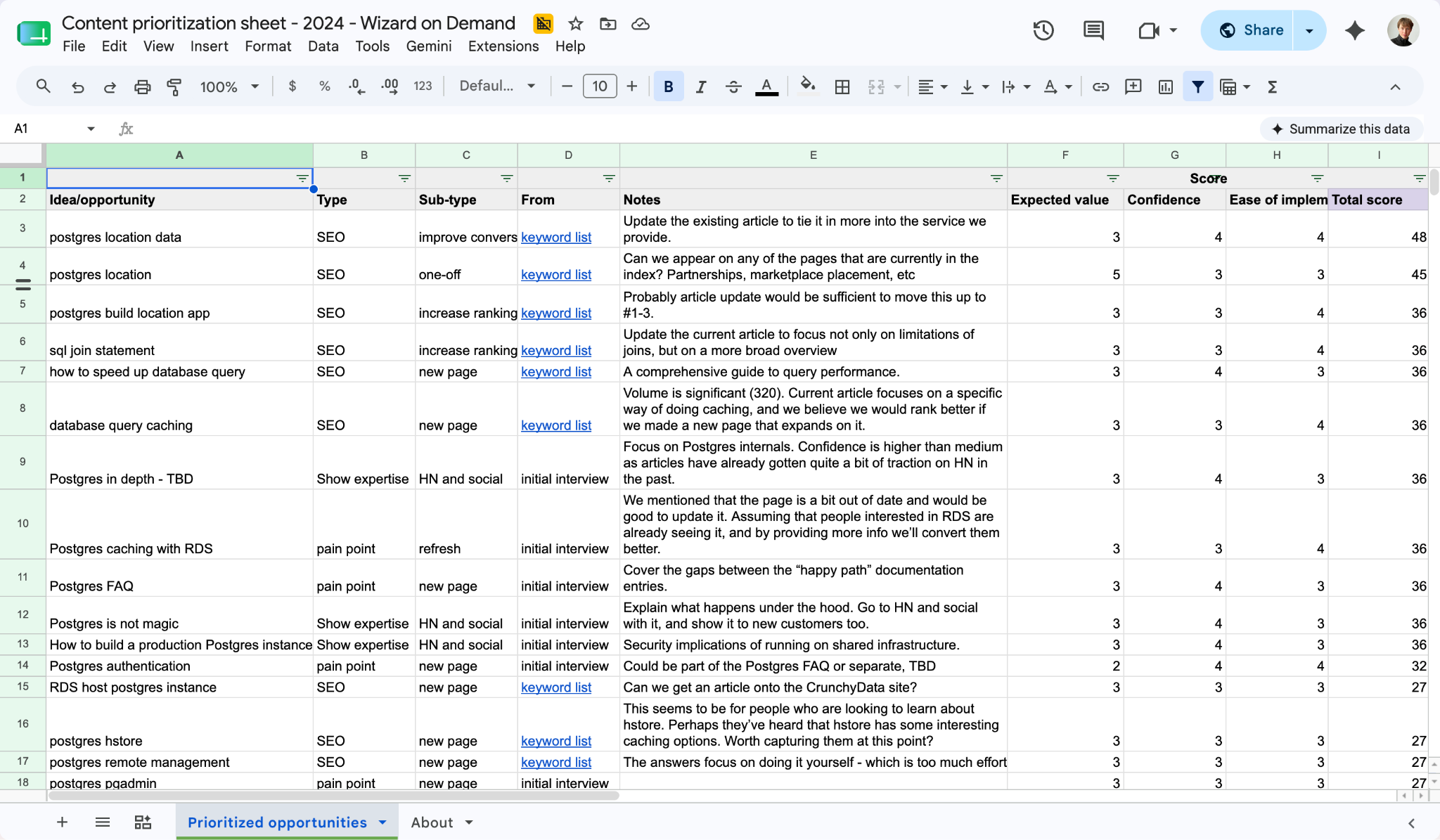
By that time, we were doing a combo of SEO and non-SEO opportunities, we were pitching angles that companies should use for each opportunity, we were scoring things a-la product management and giving out prioritised lists backed by actual likelihood of them making a business impact.
Even in 2024, this was a few levels above what everyone else was doing. The vast majority of practitioners in the field were doing about 10% of this - basically just an Ahrefs export!
People were literally hiring consultants who would go into Ahrefs, add some terms (hey, is javascript close enough to java?), export them as a Google Sheet, and present them as a "ready-to-go" technical content strategy.
They focused their shtick around how keyword difficulty is low here and CPC is high there… and this is the kind of discussion we’re still having in 2026! Which, as we all know, is about 2,000,000 internet years after 2024.
I call this "Level 0" technical content strategy.
To be clear, every building has a ground floor! It’s fine to have this! But is it enough to grow a devtool product from $10m to $100m ARR via content? Absolutely not. I think these days, this level of advice isn’t enough to get from $0 to $0.01 in ARR.
Somehow, though, I am not seeing much discussion on what can be done beyond that. I know for a fact that some organizations understand there are additional levels, but they are either intentionally not sharing the knowledge to keep their edge - or the people offering technical content marketing advice were never part of organizations that achieved serious results! It's a fun thought either way.
There are 7 levels (above ground)
I have identified seven levels of technical content strategy, each building on the layer below it. This is the stuff that the bigger organizations understand and take advantage of. Here they are:

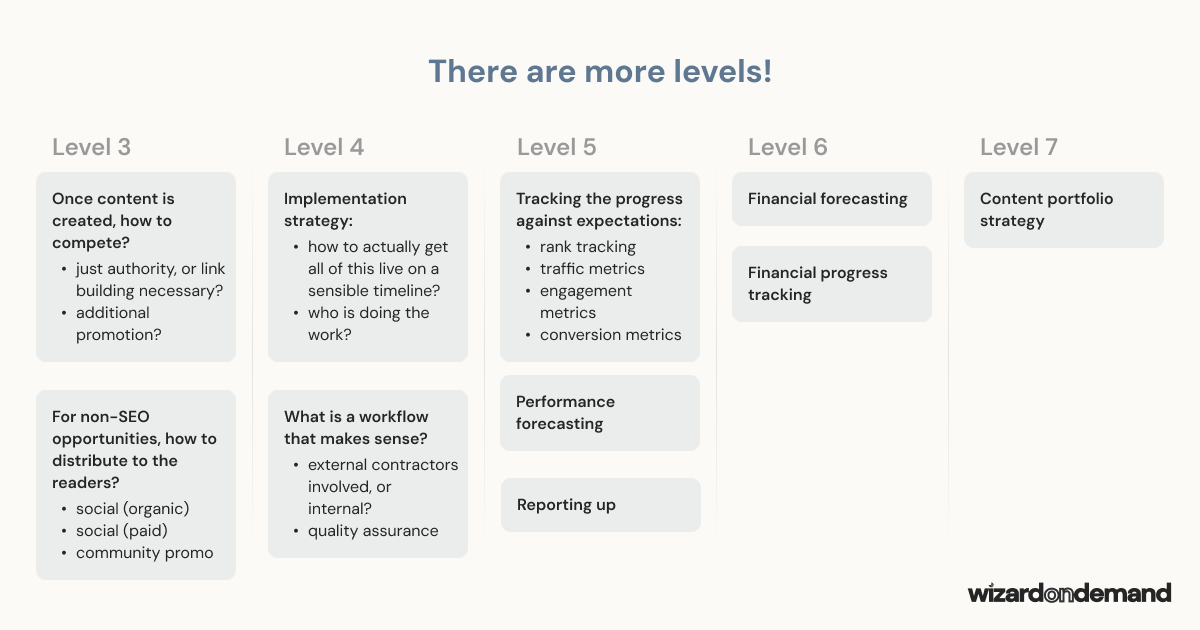
I’m going to explain them in a bit more detail below.
Level 0: The Keyword List
As I mentioned, this is the most basic level and isn't worth much today. Here are the terms, here's the competition level, and here's what's probably useful for your business, good luck.
Level 1: The Organised Keyword List
An organized, prioritized list of those same terms is, surprisingly, noticeably better! Organizing the list creates a conversation: Why is there more content around this theme? Why is this scoring higher on priority? Is this really the most important thing right now?
It's still just a list, but it's one people can discuss.
Level 2: Angles and direction
The Good Stuff® circa 2024 involved providing not just opportunities (SEO or non-SEO) but also exactly what to do with each one. For example, it would outline what angle to take that would work in your market and with your product. The strategy would define the core argument for a piece and ensure it remained consistent with arguments for other opportunities.
It's useful and better! But as we've learned since 2024, companies and marketing teams receiving this work are still often stuck on "now what?". The logical next step is…
Level 3: How to compete on a per-opportunity level
Even if you create technical content with a great angle and a solid argument, you still need a plan for:
- If it's an SEO opportunity: how to rank in positions 1-3.
This requires answering questions like: Do you have enough domain authority to rank on the strength of your argument and writing style alone, or do you need a link-building strategy? Will there be anything beyond links to drive traffic?
- If it's non-SEO: how to get initial attention and consistent traffic outside of search.
Here the question is: If search isn't going to send traffic, how will you get it? Organic social? Paid social? Community promotion? Who exactly is going to post what, where, and how many times? What's the budget (it needs to be non-zero), and what's the effort required?
Notice how opportunities feel more tangible at this level because we are removing "reach uncertainty."
Level 4: Implementation strategy (huh what?)
Okay, so everyone is now fired up about getting traffic to new opportunities - but how exactly will this get done, by whom, when, and who is accountable?
At this stage, you need an implementation process, a staffing plan, and some project management.
A crucial part is the quality assurance process. This is a large topic on its own, with many stories that I’ll leave for a separate article.
Without figuring this out, strategy won’t consistently transform into reality. And you need that transformation!
Next is…
Level 5: Performance tracking and forecasting
Once the work is moving, you need to track it against expectations. Yes, that also means you have to set expectations! Fun times.
Level 5 is about connecting your strategy to measurement and presenting it all consistently: rank tracking for SEO keywords, traffic analytics, on-page or social engagement, and conversion metrics. If the strategy was built around driving leads and signups, those numbers should eventually go up.
Alongside tracking, you need forecasting: What should be happening by when, and how do we know if it’s moving in the right direction?
This is also where leadership reporting comes in, via dashboards, presentations, regular email updates, probably a combination thereof.
Level 6: Financial forecasting and return on investment (gasp!)
Do you want your technical content program to keep getting funded? Probably! In that case, you will eventually need financial forecasting.
Level 6 means getting into the moneys:
- What is the total investment in this program, including staff time, compensation, tools, contractors, design, and development?
- Are there options for making this investment, such as spreading it out or concentrating it into a shorter period? If yes, which is optimal?
- When is the organization likely to see a return on that investment, given different risks and performance scenarios?
A few months into a program managed with this investment mindset, you will also need financial progress tracking. This shows not just whether traffic is growing, but where you are on the expected path to ROI 👑 and whether the program is economically sustainable.
Level 7: Content portfolio strategy
This is the ultimate level that I could think of at this time.
Once you have financial forecasting and a functional structure from strategy to execution, you can reason about content programs as investments, each with expected returns, constraints, and market dynamics.
Like an investor, you will make capital allocation decisions: which content programs should get more or less funding, and when.
Also, at this point, you are allowed to get this hat.

Most of the industry is still on levels 0-2. We’re changing that
Most of the industry is still stuck at Levels 0–2. Many folks are stuck at Level 0.
You don’t have to be one of them.
I’ve just shared a roadmap that took me about eight years and millions in various currencies in our clients’ and our own capital to figure out.
Progress through these strategy levels, and you’ll see your results multiply.